How to Live Voice Translate YouTube Videos on the Web?

You found a video that's exactly what you needed (a tutorial, a product launch, a lecture, a creator you love) and it's in a language you only half-follow at normal speed. YouTube's auto-translate captions aren't there, or they lag, or the creator never turned captions on at all. You don't want to scrub back and forth or paste the URL into three different tools. You just want a private realtime voice translator that runs on your side and turns what's being said into the language you understand best, while you watch.
That's exactly what a browser-tab capture setup gives you. It turns any YouTube video into a free personal interpreter that you control entirely and can point at any language pair. This guide walks through the one reliable way to do it, end to end.
Why YouTube doesn't just translate the audio for you
YouTube's own tools fall short for real voice translation. Auto-translate captions only appear when the creator enabled auto-captions, the translation often lags the audio, and plenty of videos either disable captions or run them in the source language only. None of it speaks the translation out loud, and there's no toggle that says "read this video to me in my language."
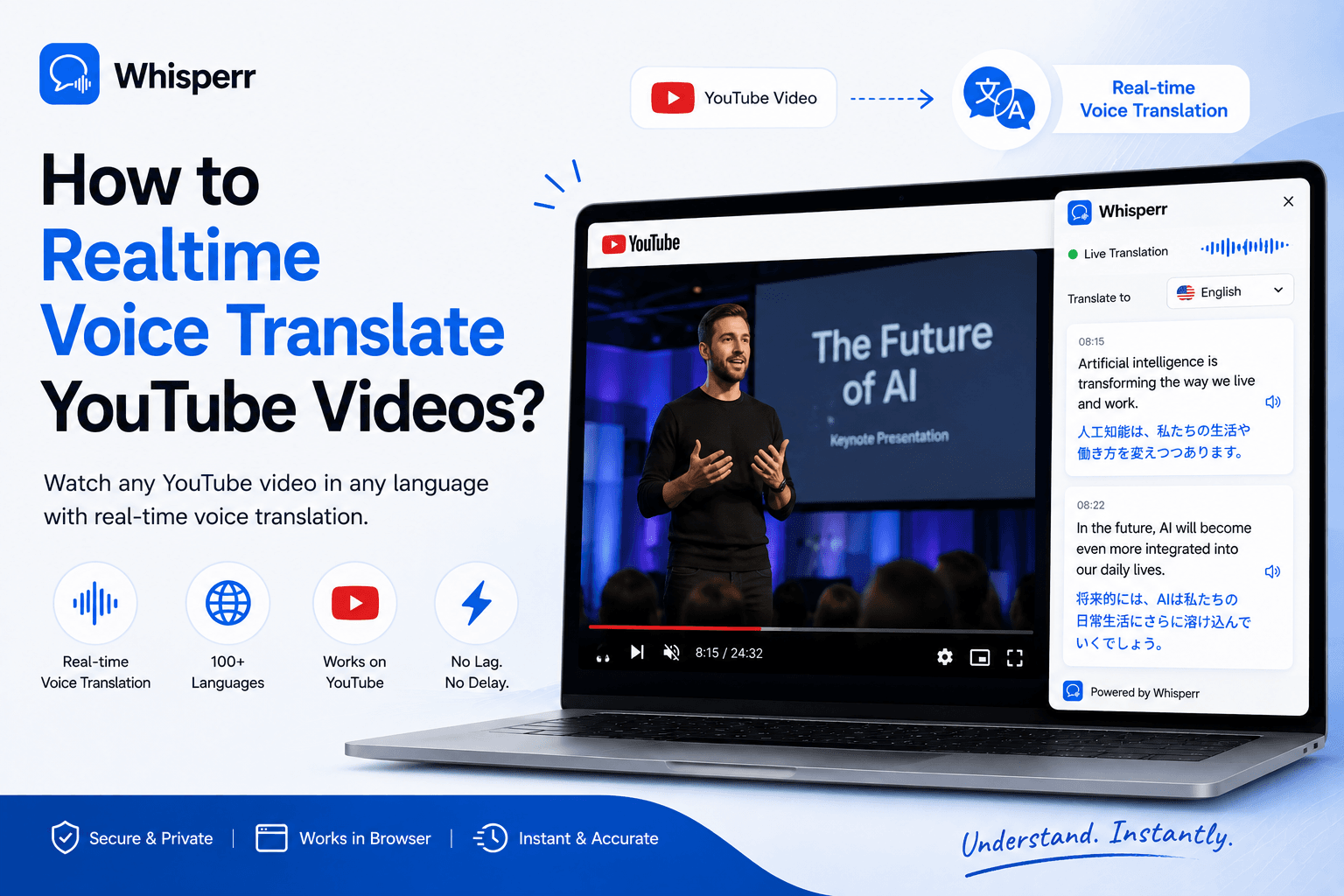
The workaround is to treat the YouTube audio like any other audio source and pipe it into a translation layer that runs alongside the video. Whisperr is built exactly for that. It captures whatever audio is playing in a browser tab and gives you live voice translation, spoken aloud and captioned, in 100+ language pairs. Point it at your YouTube tab, pick your languages, and you've got a realtime voice translator working for you.
This is the same browser tab-capture pattern used for Zoom calls, Microsoft Teams meetings, and Twitch streams. YouTube is just one more audio source it works with.
What you need before you start
- A Whisperr account. The free tier is enough for short videos.
- A laptop or desktop with Chrome or Edge — tab-audio capture needs a Chromium browser, so Safari and Firefox won't work here.
- The YouTube video you want to translate, open in a browser tab.
The one way that works: capture the YouTube tab
This is the cleanest setup. The video is already playing in a browser tab, so you just let Whisperr capture that tab's audio directly. No microphone, no speaker, no second device. The audio goes from YouTube's player straight into Whisperr, before it ever reaches your ears. It works with headphones or AirPods too, because the capture happens digitally.
Step 1: Open the YouTube video in a browser tab
Open the video you want in your browser the way you normally would. Because YouTube already runs in a tab, there's nothing extra to set up here. Just make sure the video is the one you want and keep the tab open. Whisperr captures audio from a browser tab, so the video needs to be playing in a tab, not a separate app or a cast to your TV. Any modern browser works, whether that's Chrome, Edge, Firefox, Safari, Brave, or Arc.
Step 2: Open the Whisperr web app in a second tab

In a new tab, open the Whisperr web app and sign in. Don't close the YouTube tab. Whisperr needs it open and playing to capture the audio.
Step 3: Pick the two languages

Use the two language dropdowns at the top of the Whisperr interface and pick the language the video is in and the language you want to read, for example Japanese and English. You don't have to label one as the source and one as the target. Whisperr handles voice translation in both directions by default and the order doesn't matter. If you only want one direction, see the next step.
Step 4: Set one direction (recommended for videos)

For a two-way conversation, leaving it on both directions is handy. But a YouTube video is one-way (you're listening, not replying), so the cleanest setup is to tap the arrow button between the two language selectors to switch to one direction. That way Whisperr only translates the video's language into yours, and you get a single, tidy stream that reads like a private interpreter instead of clutter you don't need.
Step 5: Enable Live Speech

To hear the translation spoken aloud, enable Auto-speak translations. If preferred, set the Speaking Speed to whatever suits your ears. Use headphones so the spoken translation doesn't bleed back into the capture. This is what turns the captions into a true speech translator feed. The video plays, and Whisperr reads you the meaning in your language right alongside it.
Step 6: Start a New Recording and choose Screen Capture

Click New Recording, then click the recording icon and choose Screen Capture (browser tab audio only). A picker pops up.
Step 7: Pick the YouTube tab and share its audio

In the picker, choose Tabs, select your YouTube tab, make sure Share tab audio is ticked, and click Share. This is the single most common thing people forget. Without the audio box ticked, Whisperr gets the video but no sound, and there's nothing to translate. Once you share, Whisperr immediately starts capturing the video's audio.
Step 8: Split screen for readability

You can split the YouTube tab alongside Whisperr by clicking New Split View with Current Tab, which lets you watch the video and read the translations side by side without switching back and forth.
Step 9: Listen and read along

That's it. The video plays normally, the spoken translation comes out of your speakers or headphones, and the translated captions stream onto your screen in your language. Everything runs entirely on your side, so nothing is changed on the video or visible to anyone else. This is live voice translate in practice: you watch, and the meaning follows along.
Why this beats the alternatives
It's genuinely free for short videos. The Whisperr free tier covers quick clips, so you're not paying for a dubbing service or a per-minute translation tool just to follow one video.
It speaks, not just subtitles. With Auto-speak on, you hear the voice translation in real time instead of pausing to read, closer to a dubbed version you control.
It works without a loud speaker. Tab capture grabs the audio digitally, so headphones and AirPods work fine. Useful late at night, in a shared space, or an open office.
It's platform-agnostic. The same tab-capture flow works on Zoom, Google Meet, Microsoft Teams, Webex, Twitch, Discord, and any other audio playing in a browser tab. One workflow, every platform.
100+ language pairs, including the long tail. Japanese, Korean, Spanish, Russian, Mandarin, Vietnamese, Portuguese, Polish, Thai, and the rest, including the ones most consumer tools under-serve. Live audio translate even on the harder pairs.
Frequently Asked Questions
Does YouTube have built-in realtime voice translation?
Not really. YouTube's auto-translate captions only appear when the creator enabled auto-captions, they often lag the audio, and many videos run them in the source language only or not at all. None of it speaks the translation out loud. Running Whisperr alongside the video is what gives you a real spoken translation on the free tier.
Will it work on regular videos, not just live streams?
Yes. Tab capture treats the YouTube player like any audio source, so regular uploads, premieres, live streams, and Shorts all work the same way as long as they're playing in a browser tab.
Do I need to set a source and target language?
No. You just pick the two languages and Whisperr handles voice translation automatically. For a video you'll usually want to tap the arrow to set one direction, the video's language into yours, so the feed stays clean.
Do I need a loud speaker for this?
No. Tab capture pulls the audio digitally before it reaches your output device, so headphones and AirPods work fine. Headphones are actually recommended once Auto-speak is on, so the spoken translation doesn't loop back into the capture.
Can I translate a YouTube video on my phone this way?
This browser tab-capture flow is for a laptop or desktop. On a phone, the Whisperr iPhone and Android apps capture YouTube app audio directly and float translated captions over the video instead.
Try it on your next video
The whole flow, top to bottom:
- Open your YouTube video in a browser tab.
- Open the Whisperr web app in a second tab and sign in.
- Pick the two languages, then tap the arrow for one direction.
- Turn on Auto-speak translations.
- New Recording, then Screen Capture, then Tabs, pick the YouTube tab (with Share tab audio ticked), and click Share.
- Listen and read along, your own realtime voice translator, just for you.
Start a free session at the Whisperr web app.
.png&w=3840&q=75&dpl=dpl_EWJKLNau86JyZDoHzAGD44dx4hmg)
Translate YouTube live streams on Android device with floating captions on top of your YouTube app. Real time, 100+ languages, no second device.
.png&w=3840&q=75&dpl=dpl_EWJKLNau86JyZDoHzAGD44dx4hmg)
Translate YouTube live streams on iPhone with floating captions on top of your YouTube app. Real time, 100+ languages, no second device.