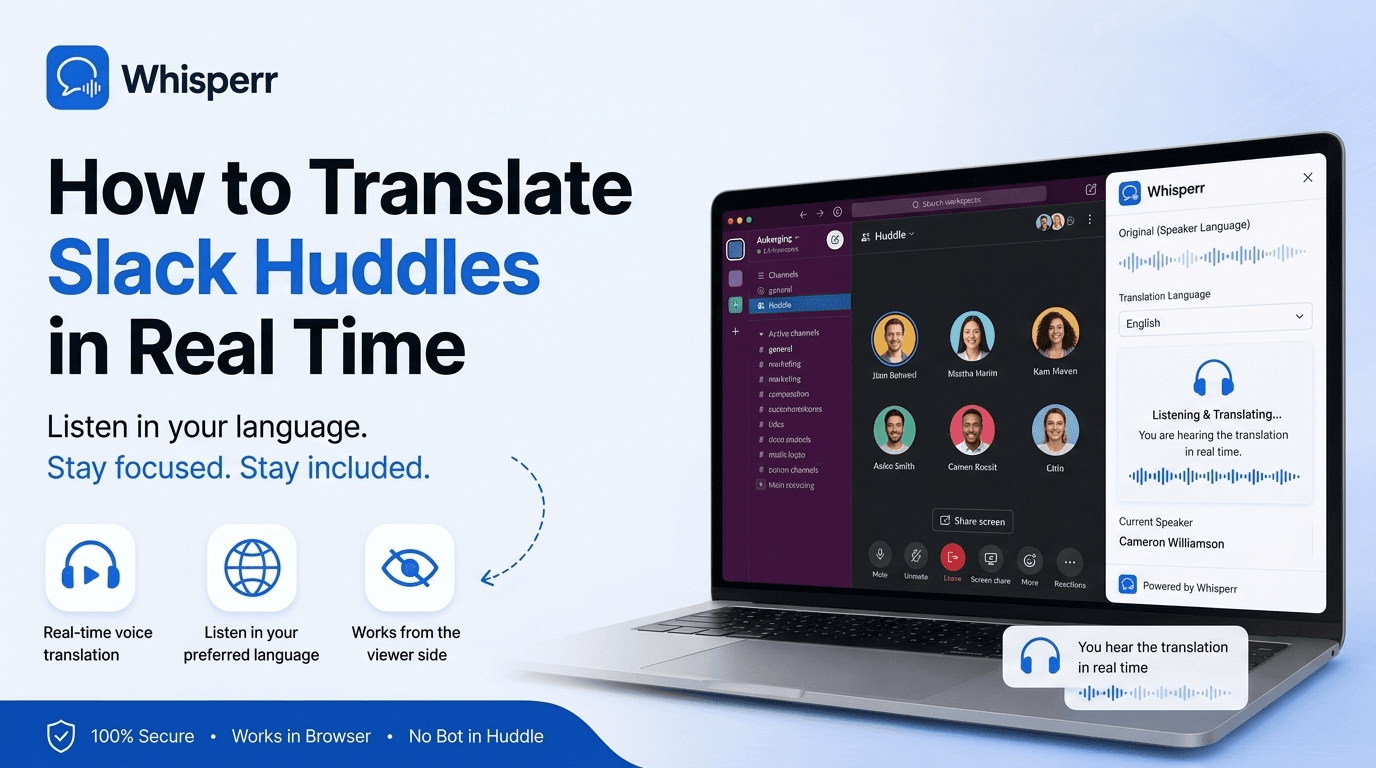
How to Translate Slack Huddles in Real Time


You're in a Slack Huddle with a teammate, a client, or a vendor who speaks a language you can almost follow, but not at full speed. You don't want to make them slow down, turn on a setting, or repeat themselves. You just want private voice translation that runs on your side of the screen and turns what they say into the language you read best.
That's exactly what a browser-tab capture setup gives you. It turns any Slack Huddle into a free personal interpreter, one that nobody else in the Huddle can see, that you control entirely, and that you can point at any language pair. This guide walks through the one reliable way to do it, end to end.

Why Slack doesn't hand you a free personal interpreter
Slack Huddles are great for quick voice and video chats, but they don't give you a private, real-time translation feed in your own language. Slack offers live captions for Huddles, yet captions transcribe what's said in the spoken language; they don't translate it into the language you read best, and there's no toggle that says "translate only the other person, only into my language, only on my screen." Huddle transcripts arrive after the conversation is over, which doesn't help you keep up while someone is actually talking.
The workaround is to treat the Huddle audio like any other audio source and pipe it into a translation layer that runs alongside Slack. Whisperr is built exactly for that. It captures whatever audio is playing in a browser tab and gives you live voice translate captions in 100+ language pairs. Point it at your Slack tab, pick your languages, and you've got a realtime voice translator working for you.
This is the same browser tab-capture pattern that works for Zoom calls, Microsoft Teams meetings, Twitch streams, and YouTube live streams. A Slack Huddle is just one more audio source it works with.
What you need before you start
- A Whisperr account. The free tier is enough for short Huddles.
- A laptop or desktop with Chrome or Edge — tab-audio capture needs a Chromium browser, so Safari and Firefox won't work here. Any Chromium browser works — Chrome or Edge.
- Access to the Slack workspace where the Huddle is happening.
The one way that works: capture the Slack Huddle in a browser tab
This is the cleanest setup. You run Slack in a browser tab and let Whisperr capture the tab audio directly. No microphone, no speaker, no second device. The audio goes from Slack's web player straight into Whisperr, before it ever reaches your ears. It works with headphones or AirPods too, because the capture happens digitally.
Step 1: Open Slack in a browser tab
Go to your Slack workspace in a browser instead of the desktop app. If Slack tries to launch the desktop app, choose the option to open Slack in your browser so the Huddle plays inside a tab. This is the one non-obvious detail of the whole setup. Whisperr captures audio from a browser tab, so the Huddle needs to be playing in a tab, not the standalone Slack app. Any modern browser works here.

Step 2: Start or join the Huddle
Open the channel or direct message and start the Huddle, or click to join the one that's already running. Keep this tab open and playing, because Whisperr needs it live to capture the audio.

Step 3: Open the Whisperr web app in a second tab

In a new tab, open the Whisperr web app and sign in. Don't close the Slack tab. Whisperr needs it open and playing to hear the Huddle.
Step 4: Pick the two languages

Use the two language dropdowns at the top of the Whisperr interface and pick the two languages on the call, for example English and Spanish. You don't have to label one as the source and one as the target. Whisperr does two-way translation by default, so it handles voice translation in both directions and the order doesn't matter. For an accurate Spanish translator feed on an English to Spanish translation voice call, this is all the setup the translation needs.
Step 5: Keep it two-way, or set one direction

By default Whisperr translates both ways, which is fine for most Huddles. If you'd rather keep it clean and only read the other person, tap the arrow button between the two language selectors to switch to one direction. That way it only translates from the other person's language into yours, and you won't see the translations you don't need.
Step 6: Enable Live Speech

To enable live audio translate out loud, turn on "Auto-speak translations" and, if you like, set the Speaking speed to whatever suits your ears. Use headphones so the spoken translation doesn't leak back into the Huddle.
Step 7: Start a New Recording and choose Screen Capture

Click New Recording, then click the recording icon and choose Screen Capture. A picker pops up.
Step 8: Pick the Slack tab and share its audio

In the picker, choose Tabs, select your Slack tab, make sure Share tab audio is ticked, and click Share. Whisperr immediately starts capturing the Huddle audio.
Step 9: Listen and read along

That's it. The other person speaks normally, and the live voice translation comes out of your speakers or headphones, while the translated captions stream onto your screen in your language. Nobody else in the Huddle sees anything. Whisperr runs entirely on your side.
Why this beats the alternatives
It's genuinely free for short Huddles. The Whisperr free tier covers quick conversations, so you're not upgrading your Slack plan or buying an add-on just to understand one person.
It's private. Whisperr runs in a separate tab on your machine. The other participants don't install anything, change any settings, or even know it's there.
You decide the direction. Two-way translation is on by default, or you can switch to one direction so you only read the other person in your language, with no extra clutter.
It works without a loud speaker. Tab capture grabs the audio digitally, so you can wear headphones or AirPods. Useful in a shared space, an open office, or late at night.
It's platform-agnostic. The same tab-capture flow works on Zoom, Microsoft Teams, Google Meet, Webex, YouTube, Discord, and any other audio playing in a browser tab. One workflow, every platform.
100+ language pairs, including the long tail most consumer tools under-serve. English to Spanish translation voice, Spanish to English, Russian, Mandarin, Korean, Vietnamese, Portuguese, Polish, Thai, and the rest.
How accurate is real-time Slack Huddle translation?
Accuracy has improved dramatically. For clear speech, a good realtime voice translator follows a Huddle reliably, accurate enough to keep up with a standup, a client check-in, or a quick planning chat. Capturing the Slack tab audio at the source helps a lot, because there's no microphone echo or room noise getting in the way.
The hardest cases are the same ones a human interpreter struggles with: heavy background noise, several people talking over each other, strong regional accents, and very technical jargon. The single biggest factor you control is audio quality, and tab capture already gives you a clean signal straight from Slack's web player.
Frequently Asked Questions
Does Slack have a free built-in interpreter just for me?
Not really. Slack offers live captions for Huddles, but captions transcribe the spoken language rather than translating it into the language you read best, and transcripts only arrive after the conversation ends. Running Whisperr alongside the Huddle is what gives you a personal, real-time interpreter on the free tier.
Will the other people in the Huddle know I'm using it?
No. Whisperr runs in a separate browser tab on your screen, not inside the Slack Huddle. Nothing appears on their end.
Do I need to be the one who started the Huddle?
No. This is a viewer-side setup. You join the Huddle like any other participant and run Whisperr on your own machine. There are no host permissions or admin settings for anyone to enable.
Can I read only the other person and not my own speech?
Yes. Whisperr is two-way by default, but you can tap the arrow button to set one direction. Then it only translates the other person into your language, and you won't see the translations you don't want.
Do I need to set a source and target language?
No. You just pick the two languages, for example English and Spanish, and Whisperr handles voice translation both ways automatically. Setting a single direction is optional.
Do I need a loud speaker or special hardware for this?
No. Tab capture pulls the audio digitally before it reaches your output device, so headphones and AirPods work fine, and you don't need any dedicated translation earbuds.
Does this work for other languages too?
Yes. Whisperr supports 100+ languages and translates between them in real time, so you can pair your language with almost any other. The same tool that handles a Spanish Huddle is a dependably accurate Spanish translator for English to Spanish translation voice, and it works across the long tail of less common languages.
Try it on your next Slack Huddle
The whole flow, top to bottom:
- Open Slack in a browser tab and start or join the Huddle.
- Open the Whisperr web app in a second tab and sign in.
- Pick the two languages, for example English and Spanish. Two-way is on by default, or tap the arrow for one direction.
- New Recording, then Screen Capture, then Tabs, pick the Slack tab (with Share tab audio ticked), and click Share.
- Read along. Your own realtime voice translator, just for you.
The fastest way to understand live Slack Huddle translation is to point it at a real conversation and watch the captions roll in. Try Whisperr on the web app, iPhone, Android, or the browser extension on your next Huddle.