
%20Hero.png)
How to Translate Google Meet Calls From the Viewer Side (No Business Account)

You're on a Google Meet where someone speaks a language you can almost follow, but not at full speed. You don't want to make them slow down, switch settings, or repeat themselves. You just want a private real-time voice translation that runs on your side of the screen and turns what they say into the language you understand best.
That's exactly what a browser-tab capture setup gives you. It turns any Meet call into a free personal interpreter that nobody else on the call can see, that you control entirely, and that you can point at any language pair. This guide walks through the one reliable way to do it, end to end.
Why Google Meet won't hand you a free personal interpreter
Google Meet has two different caption features, and the difference is the whole reason this guide exists.
Standard captions, the same-language kind, are free for everyone, including personal @gmail.com accounts. But they don't translate. Same language in, same language out. If the speaker is in Chinese, you get Chinese text.
Translated captions are the ones that actually convert one language to another in real time, and those are gated. Since January 22, 2025, Google moved translated captions behind a Gemini for Google Workspace add-on, and the meeting has to be organized by someone on an eligible Workspace business edition (Business Standard / Plus, Enterprise Standard / Plus, Education Plus, and the Gemini tiers). A participant can't unlock them from their side, and even then the feature is built for the whole meeting, not a private feed that translates only the other person, only into your language, only on your screen.
The workaround is to stop fighting Meet's caption gate and treat the call audio like any other audio source: pipe it into a translation layer that runs alongside the call. Whisperr is built exactly for that. It captures whatever audio plays in a browser tab and gives you live voice translate captions (and optional spoken translation) in 100+ language pairs. This is the same browser-tab-capture pattern we use for Microsoft Teams meetings and Zoom calls. Meet is just one more audio source it works with.
What you need before you start
- A Whisperr account. The free tier is enough for short calls. Sign up on the Whisperr web app.
- A laptop or desktop with Chrome or Edge — tab-audio capture needs a Chromium browser, so Safari and Firefox won't work here.
- The Meet link for your call.
- Headphones if you want the spoken translation, so Whisperr's voice doesn't talk back into the call.
You do not need a Workspace plan, a Gemini add-on, host permissions, or any cooperation from the other participants.
The step-by-step guide, top to bottom:
- Open your Google Meet call in a browser tab
- Open the Whisperr web app in a second tab
- Pick the two languages
- Keep it two-way, or set one direction
- Enable Live Speech
- Start a New Recording and choose Screen Capture
- Pick the Meet tab and share its audio
- Split screen for readability
- Listen and read along
The one way that works: capture Meet in a browser tab
This is the cleanest setup. You join the Meet call in a browser tab and let Whisperr capture the tab audio directly. No microphone, no speaker, no second device. The audio goes from Meet's web player straight into Whisperr before it ever reaches your ears. It works with headphones or AirPods too, because the capture happens digitally.
Step 1: Open your Google Meet call in a browser tab

On a computer, open meet.google.com (or click your invite link) in any modern browser and join the call. Meet runs in the browser by default on desktop, so there's no app-versus-browser prompt to worry about. Just make sure the call is playing in a browser tab and not a standalone window. You can join signed into a free personal account or as a guest via the link, and you don't need to be the host.
Step 2: Open the Whisperr web app in a second tab

In a new tab, open the Whisperr web app and sign in. Don't close the Meet tab. Whisperr needs it open and playing to capture the audio.
Step 3: Pick the two languages

Use the two language dropdowns at the top of the Whisperr interface and pick the two languages on the call, for example English and Chinese. You don't have to label one as the source and one as the target. Whisperr does two-way translation by default, so it handles voice translation in both directions and the order doesn't matter. For a call where you want to translate English Chinese, just set both and you're done. If you only want one direction, see the next step.
Step 4: Keep it two-way, or set one direction (your choice)

By default Whisperr translates both ways, which is fine for most calls. If you'd rather keep it clean and only read the other person, tap the arrow button between the two language selectors to switch to one direction. That way it only translates from the other person's language into yours, and you won't see the translations you don't need. On an english to chinese translation voice call, this gives you a single, tidy stream that reads like a private interpreter and acts as an accurate chinese translator just for you.
Step 5: Enable Live Speech

To have the translation spoken to you, not just shown as captions, open the options and turn on Auto-speak translations. Each translation is spoken aloud as it's confirmed, so it works like a real interpreter talking in your ear. Adjust Speaking speed to whatever suits you. Use headphones here so the spoken translation doesn't leak back into the call. If you'd rather just read along, leave Auto-speak off and skip to capturing the tab. Everything else works the same.
Step 6: Start a New Recording and choose Screen Capture

Click New Recording, then click the recording icon and choose Screen Capture (tab audio). A picker pops up.
Step 7: Pick the Meet tab and share its audio

In the picker, choose the tab option, select your Google Meet tab, make sure Share tab audio is ticked, and click Share. Whisperr immediately starts to live audio translate the call. If you forget to tick Share tab audio, Whisperr gets video frames but no sound and has nothing to translate, so double-check that box before you hit Share. Note that sharing the Meet tab to Whisperr is separate from Meet's Present now button: nobody on the call sees a screen-share, no banner appears, and the host and other participants notice nothing.
Step 8: Split screen for readability

To watch the call and read the translation at once, put the two tabs side by side. Many browsers have a built-in split view, or you can simply size two windows next to each other, Meet on one side and the live translated captions on the other.
Step 9: Listen and read along

That's it. The other person speaks normally, the spoken translation comes through your speakers or headphones if you enabled Live Speech, and the translated captions stream onto your screen in your language. Nobody else on the call sees anything. Whisperr runs entirely on your side as your own live voice translate feed.
Bonus: share the translation with others on the call
This method is set up for you, since you're the one reading and hearing the captions. But you can flip a single switch and share the live translation with everyone else on the meeting who needs it. Before you start the recording, tick the Broadcast checkbox. Whisperr generates a public room URL you can paste into the Meet chat, and anyone who clicks it reads the live captions in their own browser, on any device, with no sign-up, no install, and no Workspace plan on their end. For a genuinely bilingual call, run two Broadcast rooms with the languages swapped and label each link, so both directions work at once on a single Whisperr subscription. It's the same broadcast pattern as our Microsoft Teams guide, pointed at a Meet call.
Which situation are you in?
Your situation | What to do |
|---|---|
Joining Meet on a free personal Gmail account | This method. Translated captions aren't available to you natively, but tab capture is. |
The host is on a free account, so no one can enable translated captions | This method. It's viewer-side, so the host's plan is irrelevant. |
You want the translation spoken in your ear, not just on screen | This method plus Live Speech (Step 5). Turn on Auto-speak and wear headphones. |
You only want to read the other person, not your own side | This method plus one direction (Step 4). Tap the arrow toggle for a single clean stream. |
You want others on the call to read translations too | This method plus Broadcast. One subscription on you, free for everyone else. |
Why this beats the alternatives
It's genuinely free for short calls. The Whisperr free tier covers quick conversations, so you're not paying for a Workspace upgrade or a per-seat license just to understand one person.
Meet's native translated captions are gated and host-dependent. They require an eligible Workspace edition with a Gemini add-on, and the toggle lives with the meeting organizer, not the viewer. On a free account, it isn't an option you can turn on.
It's private. Whisperr runs in a separate tab on your machine. The other participants don't install anything, change any settings, or even know it's there.
You decide the direction. Two-way is on by default, or switch to one direction so you only read the other person in your language, with no extra clutter.
It works without a loud speaker. Tab capture grabs the audio digitally, so you can wear headphones or AirPods, which is useful late at night, in a shared space, or an open office.
It's platform-agnostic. The same realtime voice translator flow works on Zoom, Microsoft Teams, Webex, YouTube, Discord, and any other audio playing in a browser tab. One workflow, every platform.
100+ language pairs, including the long tail. English to Chinese translation voice, Korean to English, Spanish to English, Russian to English, Mandarin, Vietnamese, Portuguese, Polish, Thai, and the rest of the pairs consumer tools tend to under-serve.
Frequently asked questions
Do I need a Google Workspace or business account?
No. The whole point of this method is that it works from the viewer side on a free personal account. Whisperr captures the call audio from your browser tab and never touches Meet's account-gated caption feature.
Does the host or anyone else have to install or enable anything?
No. Everything runs on your machine, in your browser. The host doesn't need an eligible plan, and no participant has to install a plugin or flip a setting.
Will the other people on the call know I'm using it?
No. Whisperr runs in a separate browser tab on your screen, not inside the Meet call. Capturing the tab is separate from Meet's Present now, so nothing appears on their end.
Can I read only the other person and not my own speech?
Yes. Whisperr is two-way by default, but you can tap the arrow button to set one direction. Then it only translates the other person into your language, and you won't see the translations you don't want.
Do I need to set a source and target language?
No. You just pick the two languages, for example translate English Chinese, and Whisperr handles voice translation both ways automatically. Setting a direction is optional.
Do I need a loud speaker for this?
No. Tab capture pulls the audio digitally before it reaches your output device, so headphones and AirPods work fine. Headphones are actually recommended if you turn on spoken translation.
How accurate is the translation?
Whisperr is built for live, continuous speech rather than the take-turns model of phrasebook apps, which is what makes it usable as an accurate chinese translator on a real call. It covers 100+ pairs, so the quality holds up on the long-tail languages too, not just the top handful.
Is my audio stored anywhere?
Audio is processed in real time and isn't permanently stored unless you explicitly save the transcript. Nothing about the call is shared back to Google, the host, or any third party.
What about Zoom, Teams, or Webex?
Same method. Join the call in a browser tab, then capture that tab's audio with Whisperr. There are dedicated guides for Zoom (viewer side) and Microsoft Teams.
Try it on your next Meet call
The whole flow: join Meet in your browser, open the Whisperr web app in a second tab, pick your two languages (tap the arrow for one direction), New Recording, Screen Capture, pick the Meet tab with Share tab audio ticked, then read and listen along. Your own realtime voice translator, just for you.
%2520Hero.png&w=3840&q=75&dpl=dpl_8G78LDZT9j2DLbnxUKjKcBVHaK6S)
Turn any Zoom call into a private real-time interpreter using your browser and Whisperr. Free, invisible to others, works with 100+ language pairs.
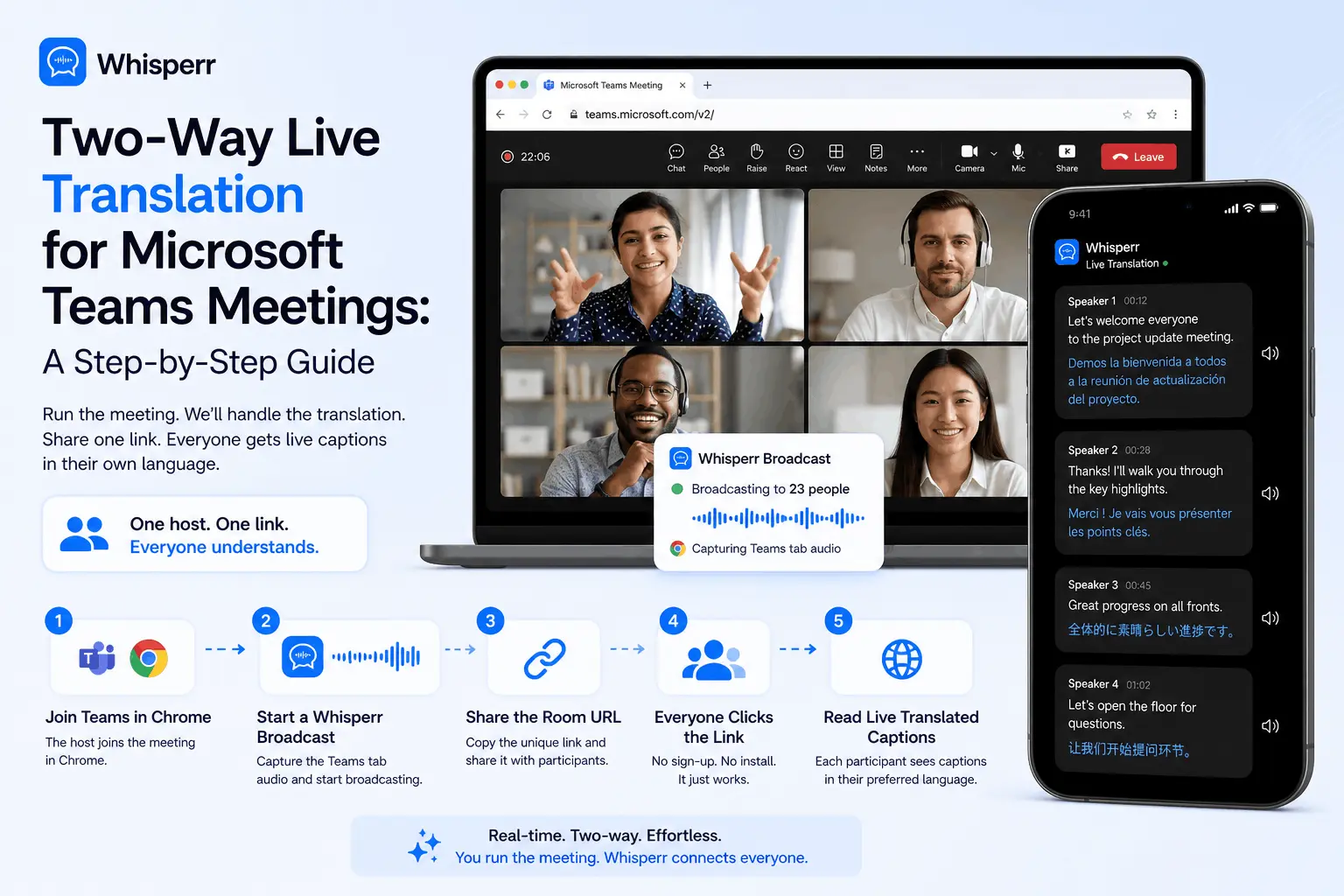
Set up real-time translation in any Microsoft Teams meeting in under 5 minutes. One person runs Whisperr — everyone else just clicks a link. No per-seat licenses. Free for viewers.