

Language barriers don't only cause awkward moments. For some people, they show up on a receipt, in a contract or in a paycheck. Whether it's a surprise fee abroad, a form signed without fully understanding it or an instruction missed on the job, the cost can be real.
To find out how much, Whisperr surveyed 504 U.S. consumers and 501 U.S. full-time workers in two separate surveys. We asked about money lost, extra money paid, missed opportunities and where people wish they'd had help understanding what was being said.
Key takeaways
- Among consumers who lost money or paid extra because they could not fully understand a price, bill, fee, contract, warranty or return policy, 73% say better translation could have helped at least sometimes.
- Among full-time workers who have faced a language problem at work, 58% say better translation or language support could have prevented one at least sometimes.
- About 3 in 10 consumers (31%) say a language barrier has cost them money.
- Among consumers who lost money to a language barrier, the average loss is $466 over their lifetime. In the past 12 months, 13% paid extra to get past a language barrier, at an average of $179.
- Nearly 1 in 10 full-time workers (9%) say a language barrier at work has cost them income over their career, with a median of about $2,000 and an average of about $3,400.
- 39% of full-time workers use a translation app or AI tool for help understanding something at work.
- 21% of U.S. consumers say a language barrier has led them to pay more, choose a pricier option or pay for extra help while traveling, at some point.
Most language-related money losses happen while traveling
Language barriers cost some American consumers money, and travel is where it happens most. Here is how those losses show up.
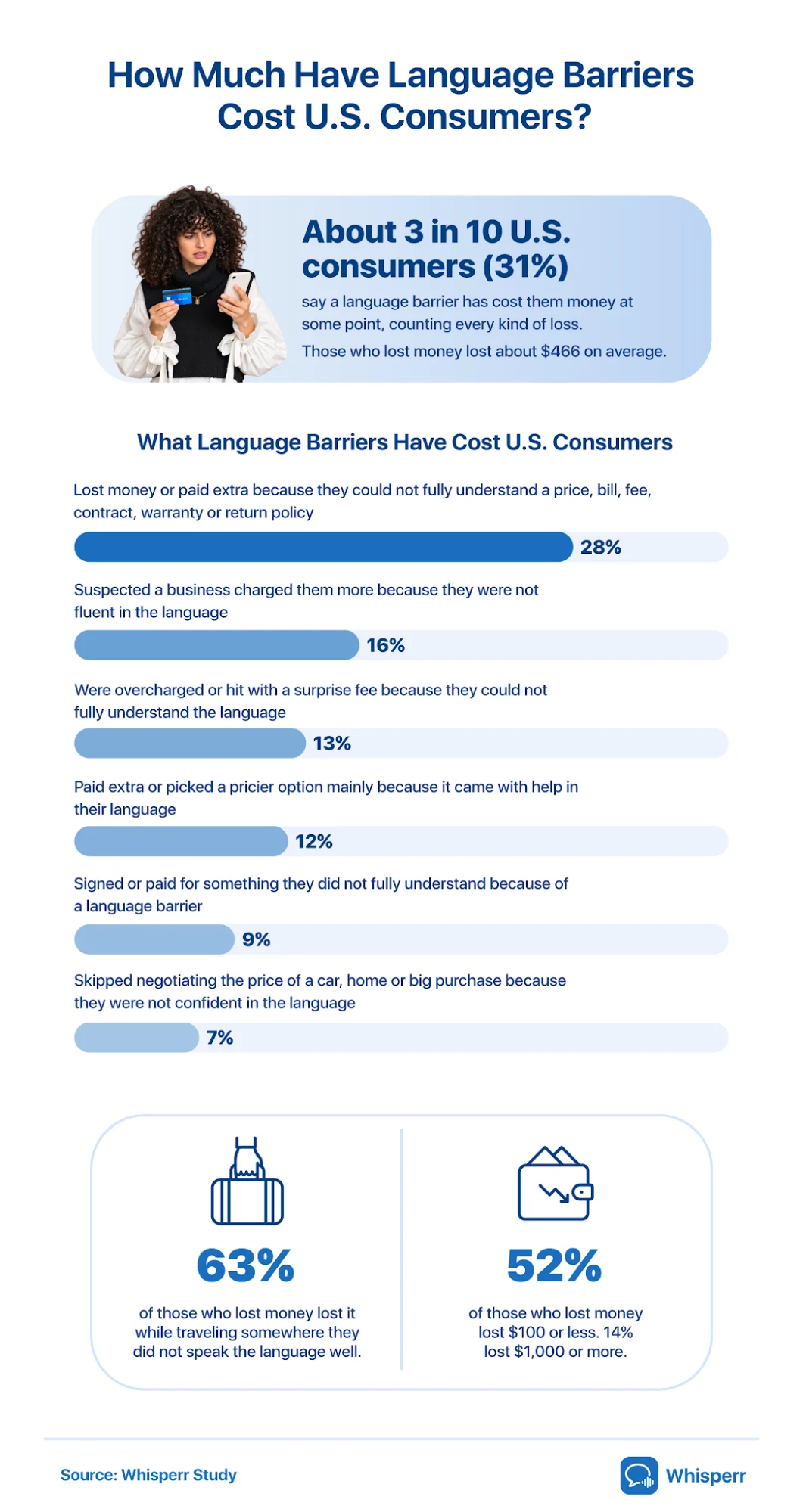
About 3 in 10 consumers (31%) say a language barrier has cost them money at some point. Among those who lost money, 63% did so while traveling to a place where they did not speak the language well. About half of them (52%) lost $100 or less, while 14% lost $1,000 or more.
Some of those losses come from not understanding the fine print. Nearly 3 in 10 (28%) have lost money or paid extra because they could not fully understand a price, bill, fee, contract, warranty or return policy.
Several specific moments stand out:
- 16% suspected a business charged them more because they were not fluent in the language.
- 13% were overcharged or hit with a surprise fee because of the language being used.
- 12% paid extra for a pricier option or a guided tour mainly because it came with help in their language.
- About 1 in 10 (9%) signed or paid for something they did not fully understand. Men are twice as likely as women to have signed something they did not understand (12% vs. 6%).
- 7% skipped negotiating the price of a car, apartment or major purchase because they were not confident in the language.
Overall, 2 in 5 consumers (40%) have faced at least one of the six situations asked about, and 1 in 5 (20%) have faced two or more.
Younger adults reported the most losses. Gen Z is most likely to have lost money or paid extra because they couldn’t fully understand a price, bill, fee, contract, warranty or return policy (40%), compared with 21% of baby boomers. Gen Z is also the most likely to suspect a business charged them more because of their language (23%, compared with 10% of baby boomers).
Contracts and fees are the hardest to understand
Paying extra to understand what is going on is pretty common. Here's who people turn to for help and what they find hardest to understand.
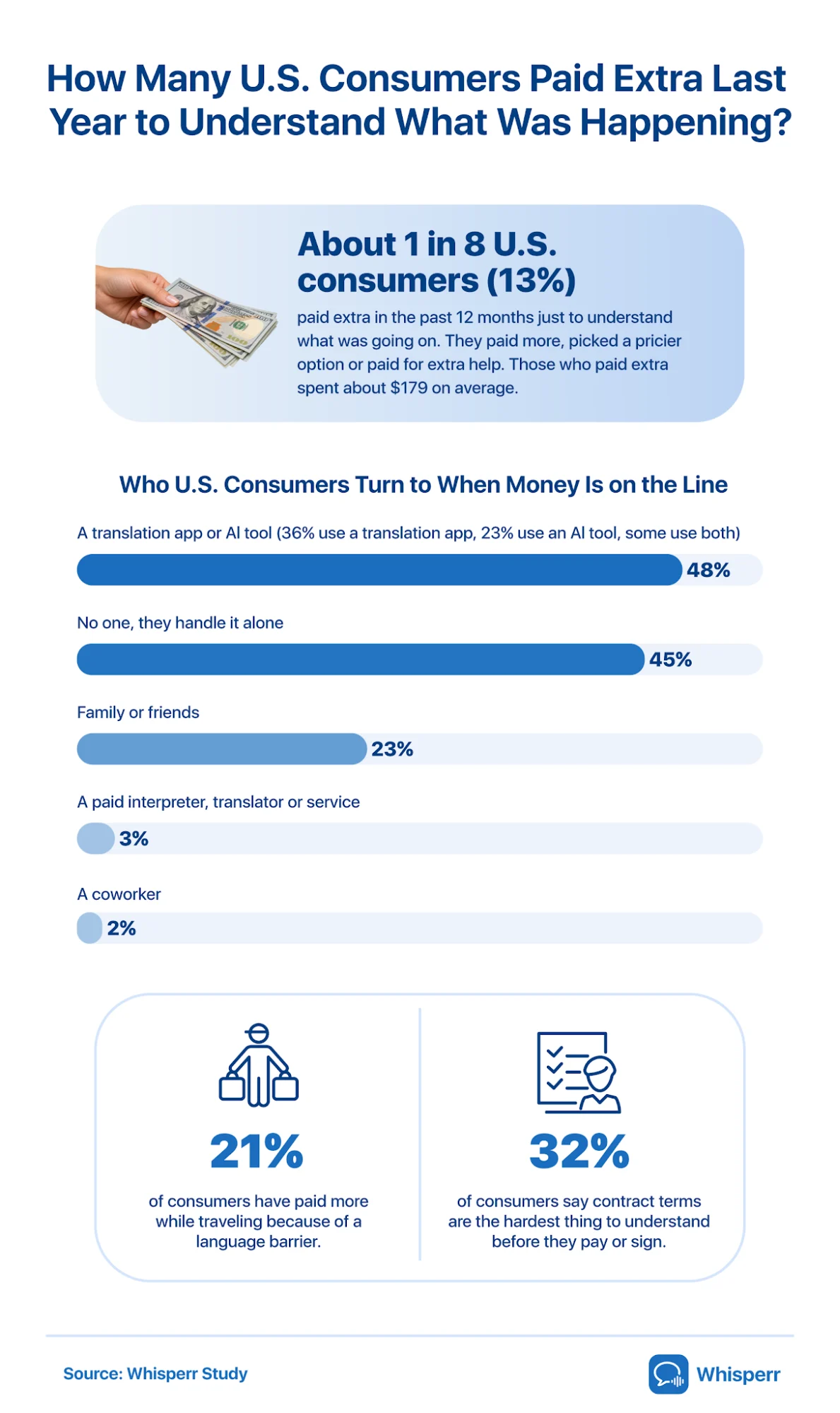
In the past 12 months, about 1 in 8 consumers (13%) paid extra just to understand what was going on, whether that meant paying more, picking a pricier option or paying for extra help. Those who paid extra spent about $179 on average. Travel was the most common situation in which U.S. consumers reported paying more because of a language barrier (21%), followed by phone, internet, or utility services (8%). Both this figure and the 13% above are shares of all consumers surveyed. The 13% covers the past 12 months, and the 21% has no time limit.
Contract terms are the hardest thing to understand before paying or signing (32%), followed by fees (24%) and loan terms (22%). Among those who lost money, 46% most want contract terms explained first, and 36% want fees explained. Among those who lost money because they could not understand a price, bill, fee or contract, nearly 3 in 4 (73%) say better translation could have helped at least sometimes.
When money is on the line, many people go it alone:
- 45% handle money problems by themselves.
- 36% use a translation app.
- 23% use an AI tool.
About 6% of U.S. consumers reported losing money after trusting a free or basic translation app that got something wrong. Those who lost money this way lost about $180 on average.
Habits also differ by generation. Nearly half of Gen Z (47%) use a translation app for money matters, compared with 23% of baby boomers. More than half of baby boomers (56%) handle it alone, compared with 32% of Gen Z.
Workers lose instructions, time and income
Language barriers follow people to work, where they can mean missed instructions, lost time and lost income. Here's what full-time workers in the U.S. told us.
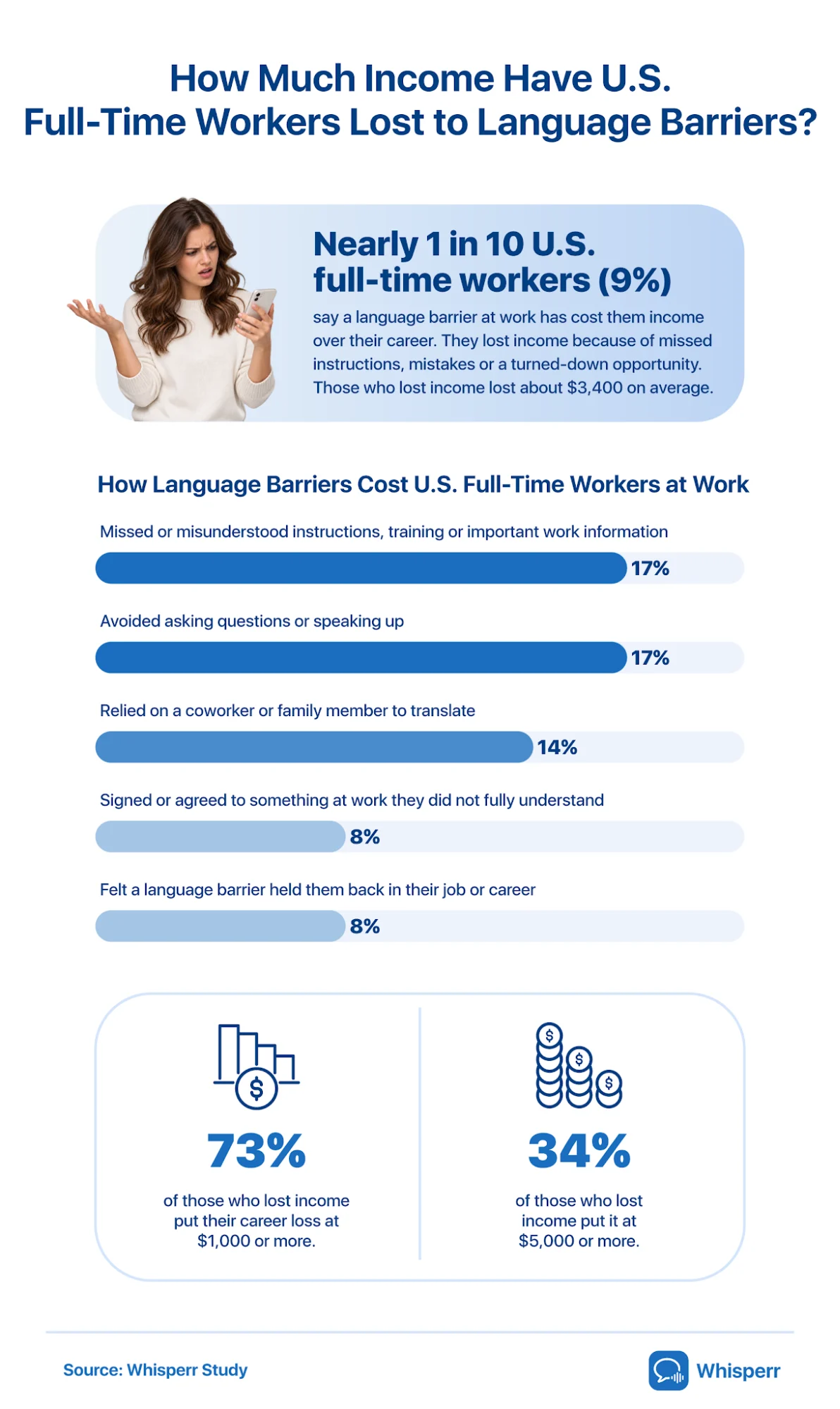
Nearly 1 in 10 full-time workers (9%) say a language barrier at work has cost them income over the course of their career. It came through missed instructions, mistakes or a turned-down opportunity. Those who lost income lost about $3,400 on average. Among them, 73% put their loss at $1,000 or more, and 34% at $5,000 or more.
More than 1 in 4 workers (28%) have faced at least one of six workplace problems because of a language barrier, and about 1 in 5 (21%) have faced two or more. The most common problems were:
- Missed or misunderstood instructions, training or important work information (17%)
- Spending time each week translating documents or preparing for meetings in a language they are not fully comfortable with (10%)
- Signed or agreed to something at work they didn't fully understand (8%)
- Made a mistake because a free or basic translation app got something wrong (5%)
- Missed out on a raise, promotion, shift or job offer (4%)
The problems tend to overlap. Among workers who missed instructions, more than 1 in 4 (27%) also signed something they didn't fully understand. Gen Z workers were the most likely to have missed instructions (28%), compared with Gen X (17%) and millennials (15%).
Workers want live translation on client calls and in meetings
Workers say live translation would help most when they are talking to customers and clients. We found out where they want it and how they cope with language barriers at work today.
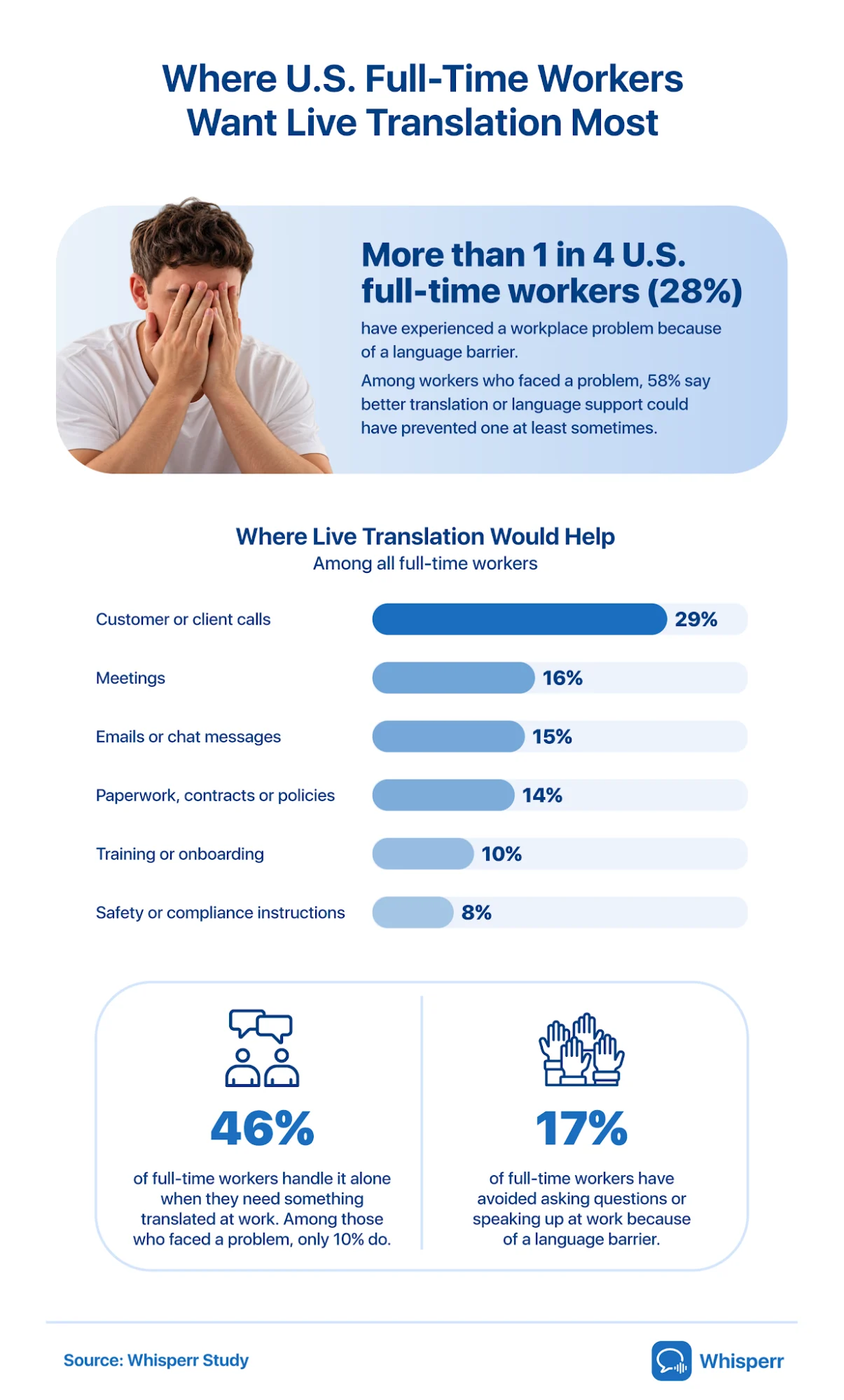
Where would translation help matter most? Customer or client calls lead at 29% of all full-time workers, ahead of meetings (16%) and emails or chat messages (15%). Beyond that, workers say live translation would help most with paperwork, contracts or policies (14%), training or onboarding (10%) and safety instructions (8%).
Women are more likely than men to want live translation on client calls (32% vs. 24%). Workers earning under $50,000 are the most likely to want it (36%), compared with 19% of those earning $100,000 to $149,999.
Today, most workers manage on their own. Nearly half (46%) handle it alone when they need something translated at work, while 28% use a translation app, 23% ask a coworker and 21% use an AI tool. More than 1 in 10 (14%) have relied on a coworker or family member to translate, and Gen Z workers are the most likely to have done so (21% vs. 10% of millennials).
Only 6% use a professional interpreter or translation service, and 4% of workers pay out of pocket for translation help or language classes in a typical year.
Among workers who have faced a language problem, 56% use a translation app or AI tool, and only 10% handle it alone. Nearly 3 in 5 of them (58%) say better translation or language support could have prevented one at least sometimes.
About 1 in 5 full-time workers (19%) have avoided speaking up or felt held back at work because of a language barrier.
Language gaps carry a price tag
Most of the money lost to language barriers is small, but it adds up across travel, contracts, fees and the workplace. The people most exposed are often the ones handling it alone, and the youngest adults report the most losses. Anyone signing a contract, reading a bill or taking instructions in a language they do not fully speak can protect themselves by slowing down, asking for key terms in plain language and getting important details in writing. Better translation could help: 73% of consumers who lost money over a price, bill, fee or contract say it could have helped at least sometimes, and so do 58% of workers who faced a language problem at work.
Understand the conversation while it is happening
Whisperr translates live speech across 60+ languages, in person, on calls and in meetings.
Try Whisperr freeMethodology
Whisperr surveyed 504 U.S. consumers and 501 U.S. full-time workers in two separate surveys. Survey data was collected October 15, 2026. The consumer survey asked about money lost or paid because of language barriers, where it happened, who people ask for help and what they most want explained before they pay or sign. The worker survey asked about missed instructions, lost opportunities, time spent translating, money spent on language help and where live translation would help most. The two groups were surveyed and reported separately.
Respondents were recruited through the Connect online research platform. Results are unweighted. With about 500 respondents in each survey, the margin of error is roughly plus or minus 4 percentage points at the 95% confidence level. Online panels are not random samples, so treat that figure as a guide. Results for smaller groups carry wider margins and are directional.
Group sizes for the figures reported here:
Consumers: 20% Gen Z, 12% baby boomers, 31% who reported a lifetime loss, 28% who lost money or paid extra over a price, bill, fee, contract, warranty or return policy, 13% who paid extra in the past 12 months and 6% who lost money trusting a free or basic translation app.
Full-time workers: 14% Gen Z, 4% baby boomers, 28% who faced at least one workplace language problem, 17% who missed instructions and 9% who lost income.
Among consumers, the average age was 42; 50% were men, 49% were women, and 1% preferred not to say or described themselves another way. By generation, 20% were Gen Z, 43% were millennials, 25% were Gen X and 12% were baby boomers. Among full-time workers, the average age was 41; 50% were women, 48% were men, and 2% preferred not to say or described themselves another way. By generation, 14% were Gen Z, 55% were millennials, 27% were Gen X and 4% were baby boomers. Percentages may not add to 100% because of rounding.
About Whisperr
Whisperr is a real-time voice translation app that lets people understand and be understood across 60+ languages, live, in person, on calls and meetings and on livestreams. It works on iPhone, Android, Mac, Windows and the web for a flat subscription with no per-minute metering. Learn more at Whisperr.co.
Fair use statement
You're welcome to share the findings and visuals from this report for noncommercial purposes. When you do, please link back to this page so readers can view the full study and provide an attribution to Whisperr.