

Deals fall apart for all the usual reasons, such as price, timing or a competitor with a better offer. Then there's a factor that sometimes goes undetected: the two sides never quite understood each other.
Whisperr surveyed 633 business leaders and workers about how language differences shape international growth and everyday meetings, as well as the career moves people are willing to make. The results show costs that fall on both sides of the org chart.
Key takeaways
- 1 in 5 business leaders say a language barrier has cost their company a deal, client or partner.
- Language breaks down most in person (42% of business leaders), ahead of video meetings (31%) and sales calls (17%).
- 80% of business leaders would pay a higher salary for a multilingual employee.
- 65% of workers who attend multilingual meetings have pretended to understand a conversation in one.
- 61% of workers would accept an overseas assignment if their employer covered language support.
Language barriers are costing companies deals and growth
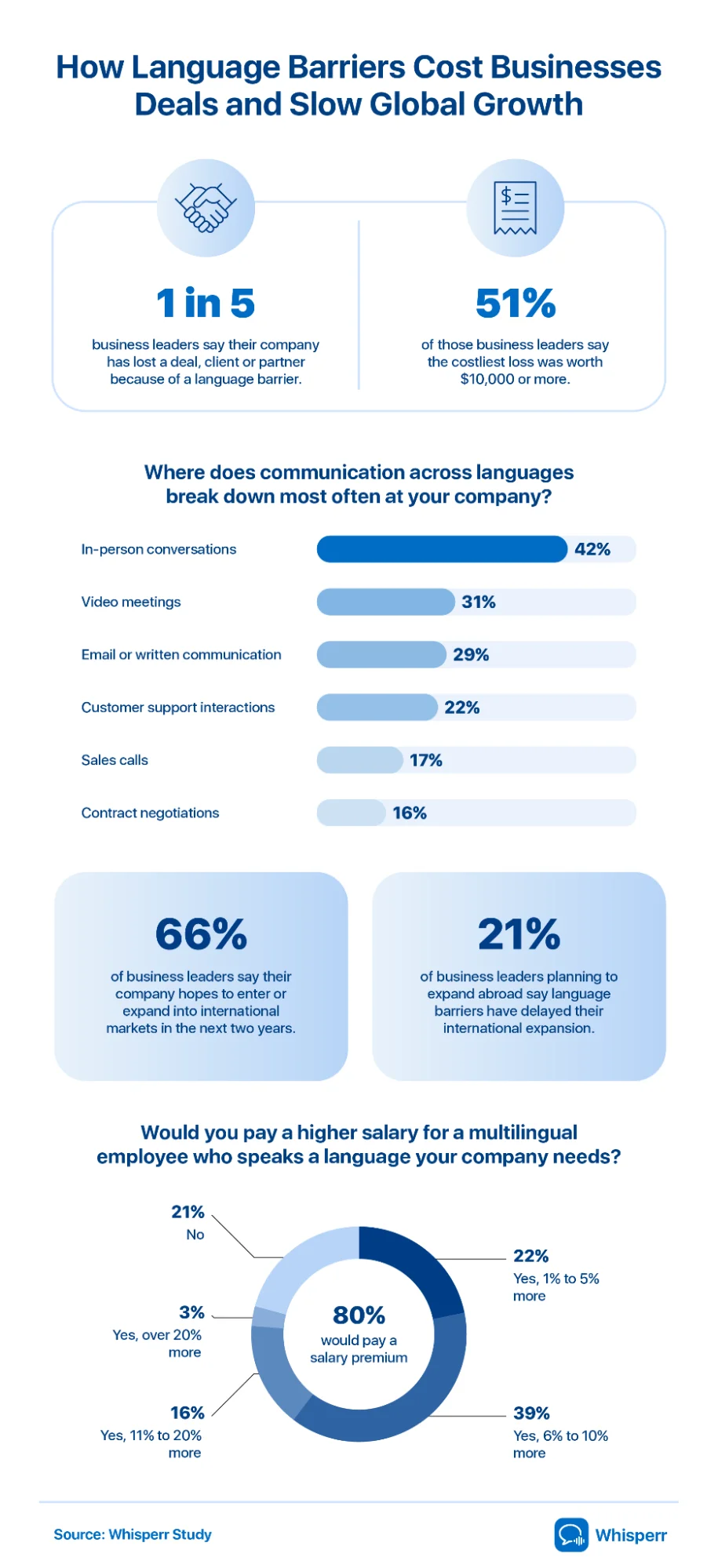
- 1 in 5 business leaders say a language barrier has cost their company a deal, a client or a partner. Among leaders with global expansion plans, 21% say a language barrier has delayed those plans outright.
- Leaders say language fails most often in person, at 42%, ahead of video meetings (31%), written communication (29%), customer support (22%) and sales calls (17%).
- Nearly half of leaders (47%) say bringing on bilingual or multilingual employees is the support their team needs most.
- 37% have hired a candidate mainly because they spoke a language the company needed, and 17% have passed over an otherwise qualified candidate who lacked that language.
- 80% of business leaders would offer a higher salary to a multilingual employee, with the range from 1% to over 20% more.
What language barriers cost workers' careers
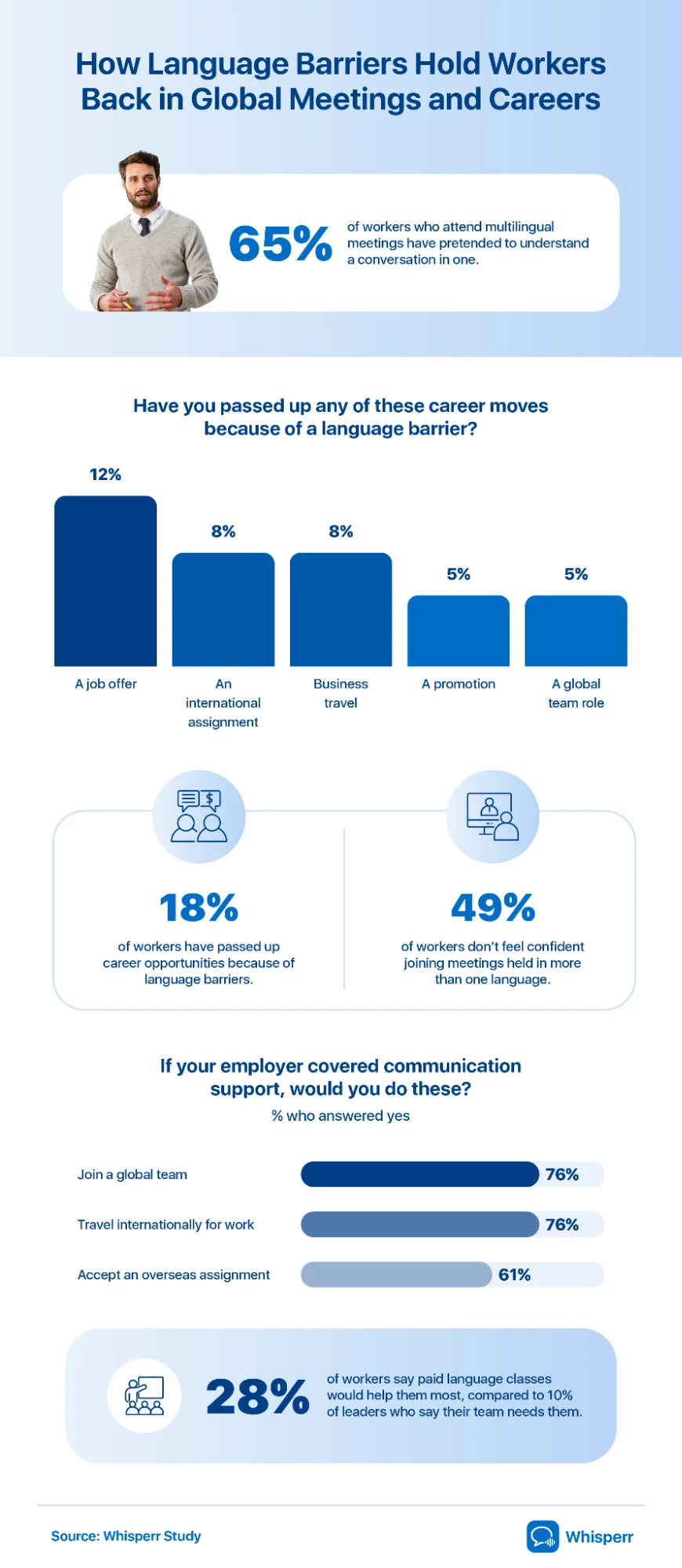
- 18% of workers have passed up a career opportunity because of a language barrier. Gen Z workers were the most likely to turn down a move for that reason, at 24%, compared with 15% of Gen X.
- 65% of workers who join multilingual meetings have pretended to understand, and about half (49%) say they don't feel confident when a meeting runs in more than one language.
- The appetite for global work is already here: 61% of workers would accept an overseas assignment if their employer covered language support, and 76% would join a global team or travel for work under the same condition.
Understand the conversation while the deal is still on the table
Whisperr translates live speech in more than 60 languages, in person, on calls and in meetings.
Try Whisperr freeMethodology
This survey was conducted in October 2026 using CloudResearch Connect. It surveyed 633 business leaders and workers to explore how language barriers affect international growth, communication at work and career opportunities. Workers were screened to include only those who regularly take part in meetings, calls, or presentations with colleagues, clients, or partners who speak a different language. Business leaders and workers answered separate sets of questions. Results were not weighted.
The average age of respondents was 39. Of those surveyed, 56% were women, 43% were men, and 1% identified as non-binary or self-described. By generation, 19% were Gen Z (ages 18 to 29), 54% were millennials (30 to 45), 24% were Gen X (46 to 61), and 3% were baby boomers (62 and older). By job level, 67% were entry-level employees, individual contributors, or supervisors and team leads, and 33% were managers, directors, vice presidents, C-suite executives, or owners, founders, and partners. Methodology percentages not totaling 100% are due to rounding.
Some questions were only asked of respondents they applied to. For example, questions about delayed expansion plans include only the 140 business leaders planning to expand abroad, and the question about pretending to understand in meetings includes only the 316 workers who have attended a meeting held partly or entirely in another language.
Subgroups reported in this study include business leaders (212) and workers (421), job level (280 individual contributors, 140 managers, 111 supervisors or team leads, 31 directors, and 30 entry-level employees), generation (121 Gen Z, 339 millennials, and 154 Gen X), gender (353 women and 275 men), and industry (147 healthcare, 99 IT, 85 finance, 50 professional services, 43 manufacturing, 38 education, and 34 government or nonprofit). Groups with fewer than 30 people, such as baby boomers, vice presidents, and owners or partners, were not reported separately. Differences between groups were not tested for statistical significance.
The margin of error is approximately ±4 percentage points for the full sample, ±7 for business leaders, ±5 for workers, ±8 for business leaders planning to expand abroad, and ±6 for workers who have attended a meeting held in another language, at a 95% confidence level. All findings are self-reported.
About Whisperr
Whisperr is a real-time voice translation app that helps people understand and be understood in more than 60 languages. It works live in person, on calls and meetings and on livestreams, across iPhone, Android, Mac, Windows and the web. With one flat subscription and no per-minute metering, Whisperr lets teams, organizations and creators keep the conversation going in any language. Learn more at Whisperr.co.
Fair use statement
Feel free to share these findings for noncommercial purposes. We just ask that you credit Whisperr and link back to this page so readers can see the full results and methodology.