
For many multilingual employees, the workday comes with a hidden second job: translation. Meetings, emails and hallway chats all happen in a language that isn't their first, and keeping up often happens out of sight.
Whisperr surveyed 736 U.S. workers who regularly use a nonnative language on the job. We asked about the workarounds they rely on, the moments they fake understanding and what language barriers cost them in time, money and confidence.
Key takeaways
- 56% of multilingual workers secretly translate their workday, and in-person conversations are the hardest to decode.
- Multilingual workers who secretly translate lose about 2 hours a week, which amounts to 15 workdays and over $4,000 in lost work time a year.
- 16% of multilingual workers have entered confidential work information into external translation tools such as ChatGPT or Google Translate.
- 65% of multilingual workers have laughed at a joke they didn't get, and 35% have agreed to something they didn't understand.
- Over 2 in 3 multilingual workers (68%) have delayed a reply because they weren't sure what a message meant.
More than half of multilingual workers translate in secret
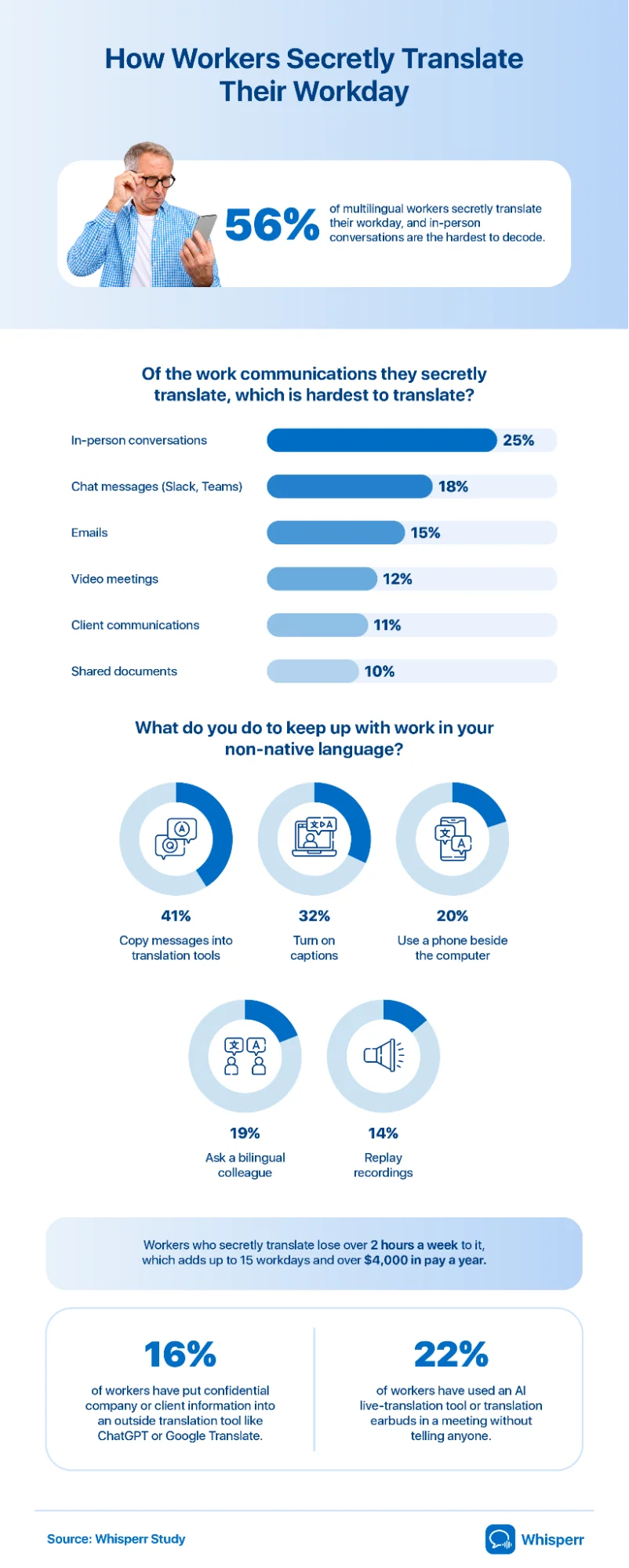
- More than half of multilingual workers (56%) secretly translate their workday, and in-person conversations are the hardest to decode (25%). Emails were the easiest to translate on the sly, chosen by 42% of these workers.
- Younger multilingual workers lean on secret translation most. Gen Z workers did so at a higher rate (63%) than millennials (58%) and Gen X workers (49%).
- Industry made a difference, too. Finance workers led at 65%, followed by healthcare (63%), education (55%), IT (53%) and government and the public sector (47%).
- The habit takes a toll on the clock. Multilingual workers who secretly translate lose about 2 hours a week, which adds up to 15 workdays and over $4,000 in work time a year.
- Some workarounds also put company data at risk. In fact, 16% of multilingual workers have put confidential work information into outside translation tools like ChatGPT or Google Translate. And 22% have used AI live translation or translation earbuds in a meeting without telling anyone.
Nodding along has real costs at work
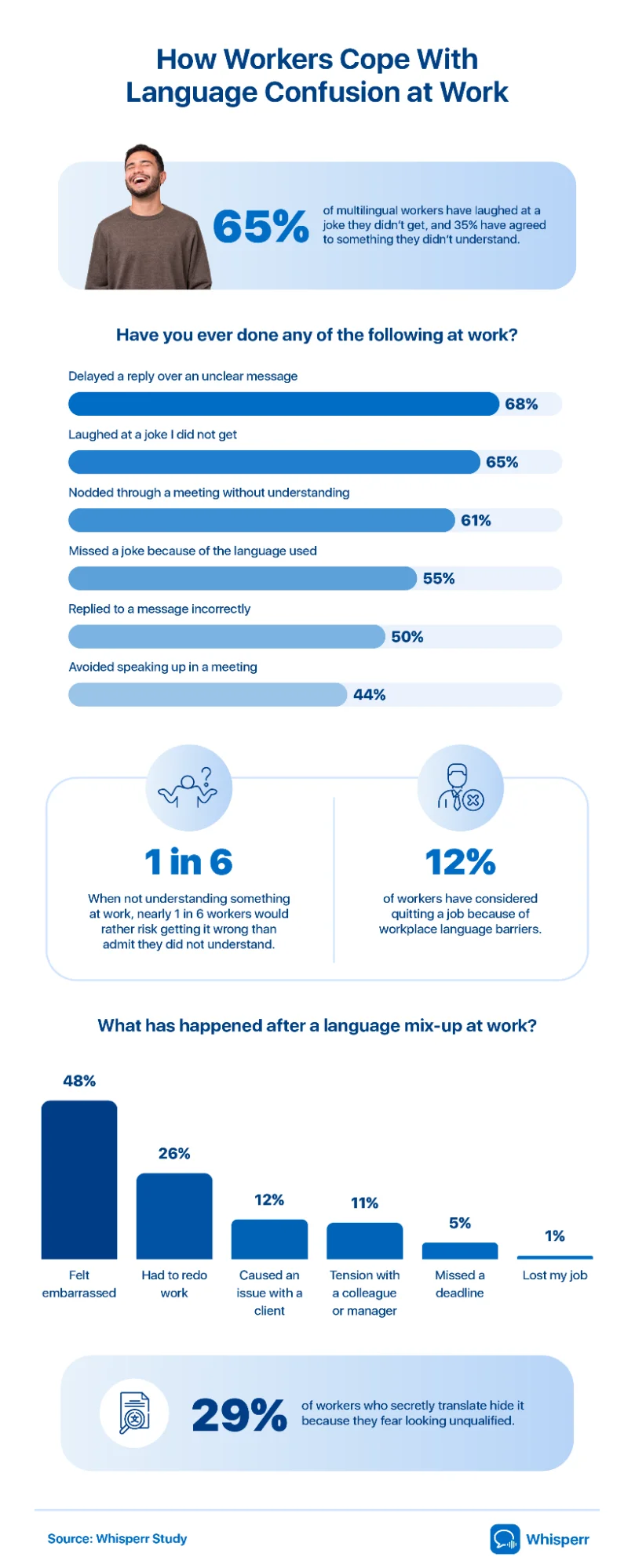
- Many multilingual workers fake understanding rather than ask for clarity. Nearly two-thirds (65%) have laughed at a joke they didn't get, and 35% have agreed to something they didn't understand.
- Gen Z multilingual workers were the most likely to nod along. 70% have laughed at a joke they didn't get, compared with 66% of millennials and 60% of Gen X workers. And 41% of Gen Z workers have agreed to something they didn't understand, versus 34% of both millennials and Gen X.
- Gen Z workers were also the most likely to say they'd rather risk getting it wrong than admit they didn't understand. About 1 in 5 (21%) said so, compared with 15% of millennials and 14% of Gen X workers.
- Uncertainty slows work down as well. Over 2 in 3 multilingual workers (68%) have delayed a reply because they weren't sure what a message meant. AI tools aren't a perfect fix either, as 15% said an AI translation tool mistranslated something in the past year, causing a misunderstanding or mistake.
- For some, the strain reaches beyond daily friction. More than 1 in 10 multilingual workers (12%) have considered quitting due to workplace language barriers.
Keep up with the conversation while it is happening
Whisperr translates live speech in more than 60 languages, in person, on calls and in meetings.
Try Whisperr freeMethodology
This survey was conducted in October 2026 using CloudResearch Connect. It surveyed 736 U.S. workers who regularly use a language at work that is different from their native language to explore how they keep up with workplace communication, the workarounds they use, and how language barriers affect their work and careers. Results were not weighted.
The average age of respondents was 39. Of those surveyed, 58% were women, 42% were men, and 1% identified as non-binary or self-described. By generation, 21% were Gen Z (ages 18 to 29), 54% were millennials (30 to 45), 23% were Gen X (46 to 61), and 3% were baby boomers (62 and older). By job level, 71% were individual contributors, supervisors, or team leads, 28% were managers, directors, vice presidents, C-suite executives, or owners and partners, and 2% selected another role. Methodology percentages not totaling 100% are due to rounding.
Some questions were only asked of respondents they applied to. For example, questions about the hardest communication to translate and time spent on translation workarounds include only the 415 workers who secretly translate. Annual time and pay estimates were calculated from self-reported weekly hours and income.
Subgroups reported in this study include job level (390 individual contributors, 130 supervisors or team leads, 120 managers, and 45 owners, partners, or C-suite executives), generation (151 Gen Z, 389 millennials, and 167 Gen X), and whether workers’ main work language differs from their native language (185 differ and 551 do not). Groups making up less than 5% of respondents, such as baby boomers and directors, were not reported separately. Differences between subgroups are only reported when they are statistically significant at a 95% confidence level.
The margin of error is approximately ±4 percentage points for the full sample, ±5 for workers who secretly translate, and ±4 for workers who have had a language mix-up, at a 95% confidence level. Subgroup margins of error range from about ±4 to ±15 percentage points, so findings for smaller groups, such as workers whose main work language is Spanish, should be treated as directional. All findings are self-reported.
About Whisperr
Whisperr is a real-time voice translation app that helps people understand and be understood in more than 60 languages. It works live in person, on calls and meetings and on livestreams, across iPhone, Android, Mac, Windows and the web. With one flat subscription and no per-minute metering, Whisperr lets teams, organizations and creators keep the conversation going in any language. Learn more at Whisperr.co.
Fair use statement
Feel free to share these findings for noncommercial purposes. We just ask that you credit Whisperr and link back to this page so readers can see the full results and methodology.